Tuesday, February 28, 2012

Why O Why?!?!...or Critique of the City-Owned Convention Center Hotel

I have been putting this one off for a while. I have been sitting on the pictures for near a month. Part of me just doesn't have the energy to once again illustrate why Dallas struggles with having a vibrant urban core. This building violates every solid urban design principle I know and I can't honestly think of one good thing to say about its urbanity. The only positive points are inside.

To that end, I will let the pictures talk for me.

The pedestrian sees only setbacks when they get to the northeast corner.

The big selling point for this hotel was that it was attached to the Dallas Convention Center. In reality, Dallas just got another skywalk/tunnel connection.

At the street level, below the tunnel. Despite the less inviting streetscape. Pedestrians still use this as much as that vaunted skywalk connection.

From the southeast corner, the setback is very clear. The ground-floor retail is not.

An illustration of one of the negative influences of setbacks. This pedestrian is trying to get from the sidewalk to the building. On the way he has to cross huge amounts of grass.

Looking south from the northeast corner.

Looking at the north side of the building, the only thing that is apparent is the valet drive up and the vast amounts of concrete for the driveway.

The east side of the building is nothing but service bays and garage. I have less of an issue with this because it is by the Jefferson Viaduct. Of all the ills, this is the least.


The valet drive dominates the north part of the property, isolating the pedestrian from the hotel.

View of the Lamar side from inside the hotel. No wonder there is little pedestrian activity in this part of downtown. What is there to walk to in this picture?

One of the few things I actually like about the hotel. They use Dallas landmarks and districts to name their conference rooms.

A friend of the family took these pictures. Another feature I like inside the hotel.

The view from inside looking northeast. Several blocks away, downtown begins.

More local pictures. Notice the pictures have no pedestrians. That is the photographers style, but in Dallas it isn't hard to find that shot.

In previous posts, I talked about the emptiness in Deep Ellum. The Omni backs that up.


These pictures are fairly recent. Main Street Gardens opened in 2009.


The view of the conference rooms on the third floor.

View from the north inside the hotel.

More Dallas landmarks.

Thanksgiving Square on the left, Old Red Courthouse on the right, the building where I got married.


Third floor connection to the Convention Center.

The main conference room is named after the city.

The third floor balcony. As usual the interior of a building in the urban core is more inviting than the exterior.

The view from the balcony looking southeast. Notice the univiting streetscape.


Same spot, looking northeast. The streetscape is still barren.


Half the rooms have this view inside. This was taken from the 22nd floor. Notice the large amounts of automobile infrastructure and low amount of urban anything.


From the same spot looking down, you can see the area where the conference rooms and garage are.

The view inside the other half of the rooms is better. Here you can see downtown, of which the most vibrant parts are several blocks away.

Despite being the most expensive hotel rooms in the city, I was amazed at how average they looked. The only "luxury" iten I know of is the bathroom mirror turns into a tv when the power is on.

A typical hallway view.

As noted in other posts, bland stairways with no meaningful connections limit their use. The Omni is no different.
I included pictures of the interior just to show the inside, though in reality, whatever is inside would have zero impact on its urban design features. I have made my objections known about the urban design, setbacks, no street furniture, empty greenspace (or is it brown), lack of pedestrian engagement, auto-dominated features, etc. In some ways, I have come to expect that from new buildings built by the private sector.

My biggest disappointment is that on the one hand, Dallas says it wants to make the urban area more inviting. They mention things that need to be done. Then on the other they produce this. They completely own this property. They could have done anything here. Even just a moving the builing east, bringing the east part of the building adjacent to Lamar St. would have made a big difference. In the end, the City that talks about revitalizing downtown, helped keep the status quo.

Wednesday, February 22, 2012

Uplift in Deep Ellum Update

Two things transpired today at Dallas City Hall as the City Council approved two items related to Uplift Education and its quest to build a school in the Deep Ellum neighborhood.

The more contentious issue, and least likely to be of any measurable effect to Deep Ellum, was the aproval of a motion to create a non-profit that will allow Uplift to buy bonds at lower interest rates. It doesn't pertain to Deep Ellum much, since they were going to build the school regardless. The savings in interest are promised to go to teacher raises, so maybe they will spend more in the area, but otherwise not a big deal as far as the urban design that is the focus of this blog.

The second item was the removal of the 300-foot barrier between new bars and existing schools in the neighborhood. Deep Ellum and downtown now share that same city code. It passed fairly easily and quickly.

We were told by the stakeholders in the area that this was their main concern. When this option was discussed during the last few weeks, there were other concerns raised, indicating to me an unwillingness to accept a high school within the area and that reasons were given to make it not work. I have said it before and I will say it again, Deep Ellum is perhaps the area best suited for an urban neighborhood in Dallas. However, in order to do that, the thinking needs to shift from an entertainment/bar district to an urban one. Bars, restaurants, schools, residences, office, hotels, etc. all can co-exist in an area. In fact, generally speaking, the more of everything, the better. This is another positive step forward in the evolution of Deep Ellum.

Monday, February 13, 2012

Urban Bus Reductions

In response to anonymous, I am going to break down how further changes to the bus system in the upcoming service changes will have a negative impact on the urban area. Similar to the simplistic method I mentioned in this post, identifying the urban areas is the first step. In my opinion, the urban neighborhoods are Downtown, Uptown, The Cedars, Deep Ellum Knox-Henderson, Oak Lawn and Bishop Arts. Upcoming neighborhoods that are close include Cedar Springs, Design District, Expo Park and North Oak Cliff (some might differ with my opinion that this is emerging. I say that because there are still many suburban designed areas, with large amounts of setbacks and parking. That also makes it more of an emerging urban area when there is no consensus). I don't include anything that is not contiguous with the urban core such as Mockingbird Station or the Medical District.

From here, identifying the buses within these neighborhoods will illustrate my point. The buses that are scheduled for adjustment in the first phase are the 21 (BA, NOC, D, U, KH), 27 (D, U), 35 (D, C), 59 (U, D, NOC), 110 (D), 111 (D), 155 (D, C), 183 (D, U), 202 (D), 208 (D), 210 (D) and 521 (U, KH). Those scheduled for the second phase are the 31 (D, U, OL), 39 (D, U, OL, CS), 49 (D, U, DD), 51 (D, U, OL, CS), 207 (D) and 283 (D).

Now several of these buses can be stricken from the discussion, the 202, 210 and the 207, as new rail additions are replacing the current service. The 283 is canceling a suburban portion of the route. The 208 is a new service. As a whole, the express route 200 series buses are of little use as urban travel. They are merely ways of transporting suburban workers to urban workplaces. While this is important, I have established previously that commuter services carry far less than their urban counterparts. Similar to the 200's is the 183, as it is adding portions to its suburban segment. While this is a good thing, it is also of little use in urban travel.

I would also excluded the 110 and the 111. Leaving downtown, they both travel over two routes toward Far East Dallas. After the change, each will be operating on only one portion, with the same total coverage as before. The 111 will have reduced times, which I will touch on in a minute, but since the 100 series are semi-express, the same rules apply, there is little the urban transportation gain from these routes.

Consequently, we can group several of the routes under their respective negative change. First up is the 35 and 49. These are going to be reduced in frequency. This means less buses plying the streets and connecting the urban areas. It is no secret that higher frequencies lead to higher ridership along the same route. Obviously, cost has to come into play, which is the reason some routes operate quite a bit more than others. If money were no object, every route would have headway's less than five minutes apart and operate 24 hours a day. Sadly, we live in the real world and DART planners have to balance operating costs with service provided. While I don't necessarily disagree with the change, it will have a negative impact on urban transport.

The 155 serves Lamar Street, but the frequency is so low that it's loss will mean very little. It's primary function was operating with limited express from the South Ledbetter area to downtown. Eliminating it will require an extra transfer, but the ridership wasn't that high anyway. It's local service in South Dallas was already served by existing rail feeders so there is no need to add a shorter rail feeder route to replace any loss of service. Again, were this an ideal setting, this bus wouldn't go anywhere, but given the constraints DART faces, I am fine with this one. However, it is still worth acknowledging its negative impact.

Another grouping is the 21, 27, 51, 59 and 39. These will have parts or all of their route eliminated. Obviously, truncated routes negatively effects the urban neighborhoods by no longer offering its services in that corridor. In the case of the 21, part of that route is being added back into a new route, the 521, but not all. It also now means an extra transfer is needed, as is the case of the 39 and the 524. The 524 is picking up the truncated part of the 39. That now means those using that portion of the service will now have to make that transfer. The 27's elimination doesn't bother me too much. It basically duplicated the Green Line, since there is very little on that route between Downtown and Parkland to act as destinations for passengers (the Harwod District in Uptown is the only exception). Some folks addressed their concern with this one in the public meetings, but I think a reshuffling of the circular's scheduling within the Medical District will alleviate some of those issues.

The 31 was addressed in the post linked above, but I'll briefly repeat. The 31 will be pulled from service on Oak Lawn to pick up the eliminated urban portion of the 51. This means a major urban street has no local bus service from downtown and only one route overall. In many ways, a lot of these changes fall under this umbrella too. McKinney has less local bus destinations if the 21 is pulled. Elm and Commerce get less buses now with the reduced headway's and eliminations, it is very easy to travel east-west in downtown because of all the different buses. It will be a little less so now. Other urban streets like San Jacinto, Pearl, Harwood, Lamar and Houston will similarly be effected.

Let me repeat, this is not a criticism of the planner's proposals but merely a look at one set of negative effects. I'd be more upset if they were trying to make a $50 million budget surplus into $60 with these changes. But as it is, they are trying to break even. Some environmental justice folks would be upset that part of the reason for the cuts is the debt incurred for building the rail system. I share part of their position, but I also understand the politics involved. I know, surprise, surprise, something involving tax dollars and public infrastructure involves politics, but that is the way of things.

Tuesday, February 7, 2012

More on Stairs

I want to follow up on one of my previous posts about how city codes can have unintended side effects. The post in question regarded stairs and how architects design them to meet codes, which consequently make stair climbing uninviting and less likely to be used outside of an emergency.

My point was that if architects were allowed to design stairs to be more than blank walls and utility conduits, people would take them more, increasing the health benefits to everyone. The Los Angeles Times reports on a study published in the American Journal of Preventative Medicine that concluded signs encouraging people to take the stairs increased their use. "The signs featured a pictogram of a man walking up stairs with text that read, 'Burn calories, not electricity. Take the stars.' The submessage read, 'Walking up the stairs just 2 minutes a day helps prevent weight gain. It also helps the environment.'"

They were placed on every floor of three different buildings and the increased use of stairs were observed in all three. While I still contend that use would increase with better design, as has been observed in places that considered that in the design phase, it might be interesting to note that overt reminders might overcome some of the tendency for humans to do what is easiest. However, it still won't overcome bad design, the kind illustrated in my wife's office building where the stairwell is only an exit on the first floor. If people have to take the elevator to the second floor, then the stairs to their final destination, well, I don't think it is hard to imagine the tendency to stay in the elevator.

Tuesday, January 31, 2012

Why Deep Ellum Folks are Opposed to a School

A little over a year ago, I mentioned what I thought to be a good plan for converting the one-way streets in Deep Ellum to two-way. However, many property and business owners disagreed with me.

Now a new development has presented itself and once again, I find myself against the flow of Deep Ellumites.

To recap the story, Uplift Education wants to buy the building located at 2625 Elm Street in Deep Ellum. They have the right to do that by zoning code. The sticky issue is that, by city code, places that sell alcohol can not be within 300 feet of a school. City staff assures the current establishments they would be grandfathered and allowed to operate after the school opened. However, any new place would not and would have to work around the code.

Understand first that I understand their point-of-view. However, I take myself beyond the boundaries of Deep Ellum and look at the situation from a holistic point-of-view. This also raises more concerns about how Dallas zoning code is suburban flavored. If you go to other major urban centers, both in the U.S. and abroad, you'll see this exact type of thing. This is an urban element pure and simple.

I favor Uplift moving into this building simply because this is exactly what Deep Ellum need to transition from an entertainment district to an urban area. Right now there are some residences, a few business's and a lot of restaurants, bars and stages. During the morning and afternoon, the place is quiet. During the evening Sunday through Wednesday, it is quiet. This is exactly the type of thing that would add activity during times where Deep Ellum has little.

The protesters are afraid this will make Deep Ellum sterile. And yet, other urban areas in Dallas haven't suffered. Downtown has numerous charter schools. Many bars and restaurants operate within 300 feet. Same thing with Uptown. Yet, I don't think some of the Deep Ellum crowd really care, as some of the comments at yesterday's meeting make me wonder.

"Kids are important. And the point is to put them in an area away from drugs and alcohol. You put these kids down here, they're not going home when school's over. They're gonna get into bars, the bar's gonna get busted, and they're gonna lose their liquor license."

So let me get this straight, you as a lawful bar owner think these students are going to go out in throngs to the area's bars. The barkeeps are going to be fooled by these kids and serve them alcohol. Then the TABC is going to be there and see this and shut the place down. And where do the drugs come in? Those aren't legal whether a school is there or not.

First, most kids won't go to the bars, though some may try. Second, most bartenders are quite able to spot a 15-year old and decipher the difference between them and the legal drinking age of 21.

Bottomline, Deep Ellum needs something different than what it has now. It' streets are vacant more than 80 percent of the time. This would drastically change that. Plus, let's not forget, that some of the teachers may well be their best customers.

Wednesday, January 25, 2012

Buses and their Role in Dallas

Yesterday, I was able to speak in front of the DART board in response to service changes the planning staff is recommending. So naturally, I shall post a blog about the situation.

The impetus is the opening of the Irving branch of the Orange Line, the Rowlett extension of the Blue Line and a park and ride/transfer center near Legacy Park in Plano. It makes sense to change some bus routes in an effort to maximize efficiency. The bus system as is was conceived without a rail component. However, adding to the issue is that DART's finances aren't in the best of shape, partly due to the economy and partly due to increasing amounts of debt to build the rail system. This has caused the planners to look at areas of the system that aren't impacted by the new openings to try and find cost savings. I went to speak specifically for the 31 route, since its rerouting would negatively impact my wife.

Staff's proposal for service in this sector is to shorten the 51 before it enters the Oak Lawn and Uptown areas and making it a rail feeder further north. They would then move the 31 onto the Lemmon and East Dallas portions of the current 51. This change would leave the 409 crosstown route as the only bus service on the lower portion of Oak Lawn and the 29 as the only route on Maple.

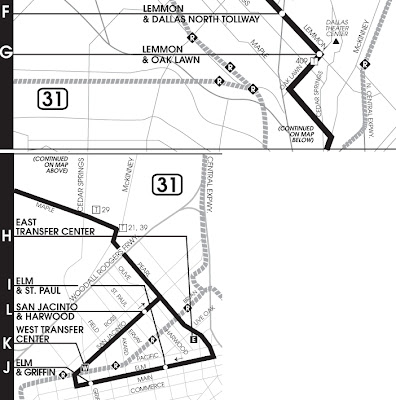
Here are the maps of the routes in question taken from DART's website.
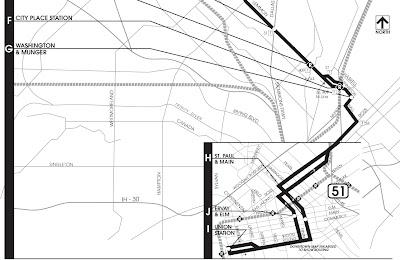
This is the 51. What is shown would no longer be in existence if the service change proposal is passed without alteration. Instead, the 31 would be rerouted to the above streets.


The 31 as it exists today. Should the service change pass unchanged, this would no longer exist, as would any local bus service on the lower part of Oak Lawn.
My main problem with this change is that it totally messes up service in the urban core. As I have noted in several previous posts, the rail system was designed as a primarily commuter system that brings in fringe residents to the core, it requires the bus system to pick up the slack as an urban transportation service. This means that in order for the urban area to operate as effectively as it should, the buses are going to have to do the work.

Because urban neighborhoods contain denser residential, office and shopping concentrations than their suburban counterparts, they need transportation services that are denser as well. For these urban areas to maintain or grow their vitality, other forms of transportation, usually in the form of walking, transit and bicycles, must be made possible. These changes could have a harmful impact in creating the vibrancy needed.

In my view, this should be how DART planners approach bus service in the urban core. The urban neighborhoods must be identified, then their streets prioritized for service. In Dallas, the primary urban neighborhoods near the core are Downtown, Uptown, Victory, Deep Ellum, Knox-Henderson, Oak Lawn, the Cedars and the Design District. Of those Uptown has one fringe station (Cityplace), Victory has one fringe station (Victory), Deep Ellum has one fringe station (the Deep Ellum named station is actually several blocks away from the actual border of Deep Ellum. Baylor Station actually borders Deep Ellum) and the Cedars has one, but it is a neighborhood without critical mass and therefore underutilized as an urban station. Only Downtown has any sort of quality rail stops.

Once this problem is identified, the buses must be routed on those main streets. Even in downtown, with decent rail service, the Elm/Commerce corridor is teeming with bus routes. Over 15 run on each street in addition to the rail system. In the Oak Lawn area, the namesake street is the "Main Street" and therefore requires the attention. Since these are all close in neighborhoods, all of them should connect to one another and downtown.

Ideally these primary streets should have multiple routes, similar to the Elm/Commerce section of downtown. As is currently the case for Oak Lawn, you can board a bus and go to: east and central Downtown, Parkland Hospital, near Love Field and NW Dallas, Uptown, Cityplace, Old East Dallas and Fair Park.

With the budget crunch, the idea that duplicate routes need to be cut will have an adverse effect on the circulation of the urban area. The ability to go many places at your doorstep without a transfer is what should separate the urban transit service from the suburban. Sadly, DART is looking at all areas of the bus system from a suburban standpoint.

The other idea lost in this change is that getting rid of duplication also has the side effect of reducing capacity. Let's assume that no one stops taking transit and everyone transfers. Big if, but it will illustrate the point. If every one of those riders on the Oak Lawn portion of the 31 switch to the 409, then the 409, without an increase in frequency, will be fuller. That isn't always a bad deal for DART, but if the 409 is at 70 percent capacity during rush hour and the 31 is at 80 percent, this section of Oak Lawn will quickly get crowded.

In defense of the planners, that would be exactly the scenario. Those folks going from downtown to destinations beyond Lemmon and Oak Lawn, will not be affected by the route change. However, they will be facing a longer ride. Since the WTC is the central point in the DART system, any bus that begins away from there will likely require extra time for passengers to get to that bus. In this case, passengers will need to begin at Union Station. That may not be a bad idea if you are coming from the southern portions of the Blue or Red Lines. But anywhere else in the rail system or any other bus will add extra time just to get to the new bus route.

Now, if both buses currently leave the starting point at the same time, the 31 riders will get to Lemmon and Oak Lawn in 12 minutes. Riders on the 51 will get there in 22 minutes. So not only will there be an increase in times to get to the bus for most riders, there will also be an increase in time for all passengers going beyond Oak Lawn and Lemmon.

Remember what I have said previously about how to do transit right. Get people from point A to point B and do it efficiently, whether that is measured in time, money, minimizing transfers, etc. This service change does the first, but regresses considerably on the second. An increase in time, an increase in transfers, longer headways and lower capacity are some some of the negative side effects. The positive is lower operational costs. If the bus system was discontinued, lower costs would be accomplished too, but obviously that wouldn't be efficient nor optimal.

Sunday, January 22, 2012

Downtown Midland: How to Revitalize

Now a heads up from my hometown of Midland, about 5-6 hours west on I-20 from Dallas. My sister directed me to a story in the local paper, The Midland Reporter Telegram, about this effort to revitalize their downtown. She sent it to me several months ago, but I procrastinated discussing it until now.

In many ways, Dallas and Midland are similar. Their downtown's were converted from the center of the city's life to an office park, they have a nearby rival city and a lot of activity has shift to the fringes. Even looking solely at the downtown area of each city reveals similarities. Each have/had vacant office buildings. Each looks great from a distance, but getting inside reveals fake density, similar to what I discussed in this post. Both have out-of-whack parking situations that depend heavily on surface lots and restrict on-street parking. In fact, in a lot of ways, downtown Midland is now where downtown Dallas was 15 years ago. There are even intangible similarities like old money still controls each area and elected officials that do not quite know what is going on in the area or really what is needed to get where they want downtown to go.

This would fit right in if it were in downtown Dallas.

Note the cluster of tall buildings, as well as the vast amounts of surface parking.
Some excerpts from the article that will form the basis of my discussion:

City leaders, along with members of the Tax Increment Reinvestment Zone (TIRZ) board, the Downtown Midland Management District (DMMD), Midland County and the Midland Development Corp. (MDC), among others, have been meeting regularly since the spring to create a unified vision for the future of downtown.
The DMMD in July brought its executive director on full-time. The city also is looking within the next 60 to 90 days to hire -- in conjunction with the other entities -- a full-time employee who would work to develop a "catalyst" project for downtown and to eliminate obstacles that prevent that type of development, City Manager Courtney Sharp said.
What exactly that catalyst project will be still is up for consideration, downtown advocates said. But, they agreed for the first time the entities all are working together toward a common revitalization, rather than each acting separately to achieve essentially the same goal.

...

[Natalie] Shelton [DMMD Executive Director] said she'd support a mixed-use property that would allow for office space on the upper floors and retail or restaurants on the ground-level. Some members of the DMMD said the renovation of the Ritz Cultural Events Center could be a catalyst of sorts as it aims to bring several hundred people downtown at least a few nights a week.
Others have pointed to a combination of possibilities.
"Office space is needed immediately," [Jerry] Morales [at-large City Councilman] said.

...

Gary Glasscock, partner at Tgaar Properties Inc., said they are moving their offices back downtown after operating from farther north for the past several years.
The company purchased Wall Towers east and west, which are about 30 percent occupied, and plans to update the remainder of the buildings to open more office space, he said.
"We've already signed up several leases," he said, adding they've had interest from businesses locally and nationally. "Once that begins we'll start renovating."
Still, he said, there are challenges to re-doing old structures. They're presently conducting a study to determine if asbestos exists in the structures and anticipate it will take about $5 million to fully restore the properties.
"Once you get past the basic issues, this has great bones," he said of the property. "It's a first-class area to be in."

...

Aside from the cost required to bring some buildings up to code, parking issues prevent downtown from thriving, Morales said.
Glasscock said they have an agreement to lease spaces just east of the library, but a lack of parking is prohibitive.
If there were a few developers committed to coming downtown and bringing jobs, Morales said they then could assess where it would be feasible to put a parking garage.
If I were to change Midland to Dallas and the names of the entities involved, this would be just like Dallas' situation. The basic problem as it stands today is that there are too many chiefs and not enough indians. When that situation exists, there are a lot of ideas on what needs to be done. In this case, one wants a cultural institution, one wants office space, some want a parking garage and others want mixed-use office/retail. None of the serious flaws that exist now are addressed. Midland has great bones. That is it. What was proposed does not add the flesh to downtown.
The Councilman wants more office now. The company official bought two office buildings that are 70 percent vacant. Those two don't mesh. Downtown Fort Worth, with an office occupancy above 90 percent in downtown can say they need mopre office. 12.5 percent of the office buildings in downtown Midland are completely vacant right now (which is to say nothing of their overall vacancy rate, which is quite high). The empty buildings are where the biggest opportunity lies. What I have experienced in Midland, coupled with what I know about vibrant urban areas, is the lack of activity outside of office hours (Dallas, anyone?). The current trend across the United States, from coast to coast, cities large and small, is that the younger generation is looking for something different than the prototypical American living situation. That is all Midland is, single-family houses and garden-style apartments. There are no townhomes, no lofts, no duplexes. Convert a handful of these empty and near empty office buildings into a residential use, try to keep them near strategic points and near each other to increase the likelyhood of critical mass and all of a sudden, things will move and they will get their catalyst. People will be walking on the street, retailers and restaurants will be attracted, and Forbes will look at them for the list of best small city downtowns.
However, Midland has not encouraged this thinking. Instead, several empty buildings, six that I can count, have been demolished instead. That is a wasted opportunity. However, the prevailing theme in Midland, like it was in many cities in the United States, from coast to coast, cities large and small, is that no one wants to live downtown. I fear that until someone actually does it, that thought will always prevail and good, solid buildings will be demoed for parking lots.
Speaking of parking ... downtown Midland has it all wrong. There is very little on-street parking, despite the wide four-and five-lane streets that prevail all over the district. You want to encourage ground floor retail? Start there. It will actual bring in revenue to the city, while at the same time reducing parking pressures on the private lots and enticing quick convenient parking for the customers of the potential retailers and restaurants the city wants to attract. I can recall only two restaurants accessible from the street in downtown Midland, and both are always packed.
I have said it before and it will never be invalidated. Urban areas will never out-suburb the suburbs. Downtown Midland will never be able to offer large amounts of surface parking like the places on Loop 250 can. Instead, they need to offer what those places can't, an inviting streetscape teeming with pedestrains. When I say activity begets more activity, that is what I mean. Sometimes people don't go to the mall to shop. Sometimes they go to socialize or people watch. Malls are nothing more than an urban streetscape covered by a roof and usually lacking the mixed-use component. When the land use encourages street-level activity, people will come to observe and be a part of it, not because of what use is there now specifically. The base activity encouraged the ancillary activity, furthering the vibrancy of the street.
Downtown Midland would have to take steps to encourage that pedestrian traffic. A big start would be the addition of the on-street parking, which then gives the pedestrians a buffer from the traffic.
Also, the idea that it takes a catlyst project or one thing to jump start development is a very outdated mode of thinking. Urban areas operate best when they are a conglomeration of lots of little pieces. One residential building with 100 units is better than none, two is better than one and three is better than two. However, it is not linearly better. In this case the sum is greater than the whole. The 300 units are far better than if each 100 units existed on its own seperately. So any policy that is geared toward a catalyst is flawed from the beginning. The focus needs to be on accumulation of several small things at once. Encourage a form-based code that dictates where you want the street-level retail. Make improvements to the streetscape, particularly shade and benches. Set-up a tax break system for certain tyoes of development, ie. residential, that will encourage private entities to look in that direction. Study where transit makes the most sense within the current land-use.
Downtown Midland has tried catalyst projects before and have seen minimal results out of the effort. Midland Center was built, yet downtown wasn't revitalized (just like the empty promises of almost every convention center in America). Centennial Plaza was supposed to be a gathering spot for locals to enjoy downtown in an open setting. But without complementing land uses nearby, it is sparesly used when an event isn't scheduled. There was a massive undertaking to remake the streets and sidewalks from regular concrete to red brick or other fancy patterns. Yet without fundamentally changing how downtown was used, there wasn't a fundamental increase or decrease in anything but the budget.
Bottomline, downtown Midland has a great opportunity, but I just have a feeling that well-meaning officials will miss the mark. Unless they bring in someone with a basic knowledge of urban design and land-use, things will not change. Midland is not different than any other city or region. If places like Fargo, North Dakota can revitalize their downtown, then so can Midland. Weather, industry or age, despite what common criticisms are leveled, will not prevent Midland from having a vibrant downtown. Misguided directions and policy will.